
Concrete to Canopy: Evaluating Toronto's Progress toward a 40% Tree Cover Goal
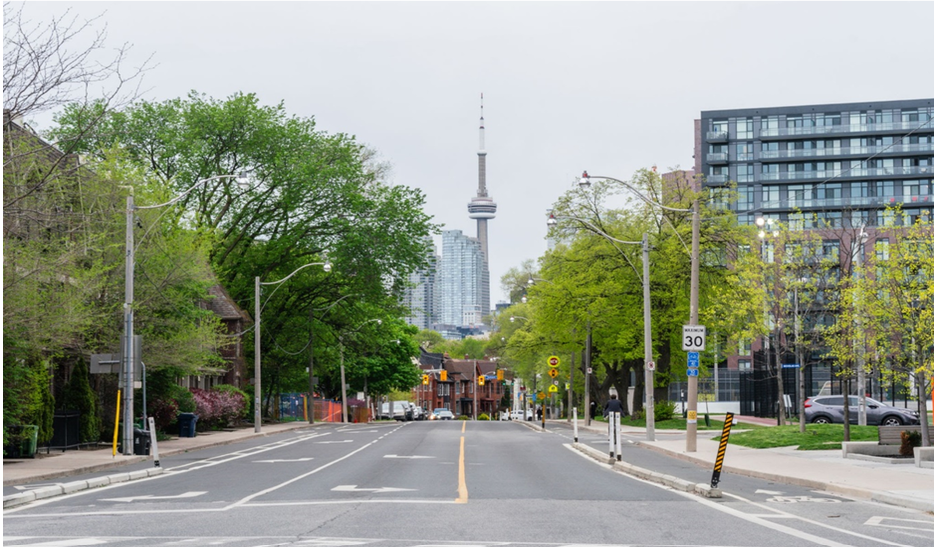
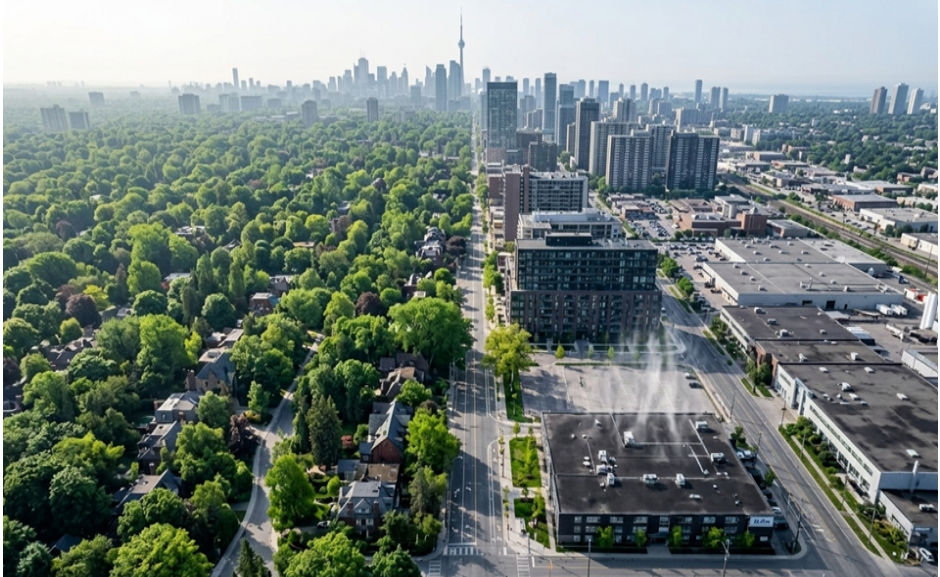
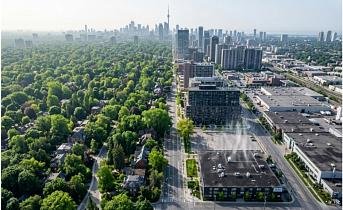

Walking down the lush, shaded avenues of Rosedale or exploring the deep, quiet expanses of the Don Valley ravine system, it is easy to see why Toronto has long been celebrated as a "city within a park." From an aerial perspective, vast swaths of the municipality disappear under a thick, vibrant blanket of green. Yet, just a few kilometres away in the soaring high-rise corridors of downtown or the industrial stretches of Etobicoke, the view shifts dramatically to glass, asphalt, and concrete. As Canada’s largest metropolis grapples with an unprecedented housing crisis and skyrocketing residential development, a quiet war is being waged at ground level over the future of the city's urban forest.
“At the centre of this battle is the City of Toronto’s ambitious target to expand its tree canopy cover to 40% by the year 2050 a goal reaffirmed by City Council to align with its transformation to its net zero strategy”.
Currently hovering between 28% and 31% coverage, urban forestry initiatives are running headfirst into the compounding pressures of rapid intensification, aging tree populations, and deep-seated neighbourhood inequalities.
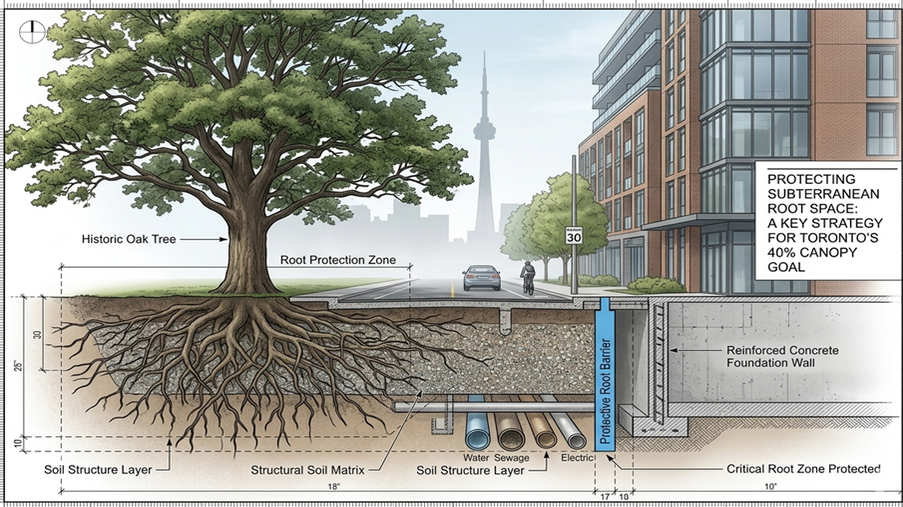
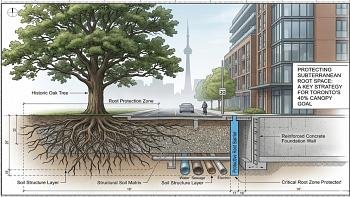
The critical balance: Toronto planners face the challenge of preserving mature tree root systems while rapidly building up dense urban housing corridors.
The Development Squeeze
The most significant hurdle to expanding Toronto's green canopy is not a lack of political will or public enthusiasm; it is a lack of physical space. To combat the housing supply shortage, mid-rise and high-rise infill developments are accelerating. But as multi-unit buildings replace single-family homes and parking lots, the open soil required for large trees to thrive is rapidly disappearing. According to the city’s most recent comprehensive Tree Canopy Study, Toronto’s total plan table space actually decreased by 2% over a ten-year period, while non-plan table, impervious surfaces like concrete foundations, sidewalks, and asphalt crept upward.
"While public support of the urban canopy grows, cities continue to cave to the powerful forces of development," notes Dr. Danijela Puric-Mladenovic, a professor of urban forestry at the University of Toronto and co-founder of the Neighbourhoods project. "Despite its lofty forest-expansion ambitions, Toronto has seen its portion of tree space decrease in the last decade and impervious land cover increase."
When developers excavate deeply for underground parking garages, they frequently slice through critical root zones or alter local hydrology. The result is that nearby mature trees often suffer slow, correctable declines years after construction crews have packed up.
The Myth of One or One Replacement
To offset the impact of development, city bylaws require builders to plant new trees or pay into a municipal fund if a mature tree must be removed. However, urban foresters warn that a newly planted sapling cannot simply be swapped for a century old oak. A mature tree with a 75-centimeter diameter intercepts ten times more air pollution, stores up to 90 times more carbon, and provides roughly 100 times more cooling leaf area than a young 15-centimeter sapling. While the city plants over 100,000 trees annually on public lands, the mortality rate for young street trees in harsh urban environments can be staggeringly high due to soil compaction, road salt, and lack of water.
In recent policy reports evaluating strategies to protect growing space for trees alongside infill housing, city staff emphasized that keeping existing trees alive must take precedence over simply planting new ones. The structural replacement value of Toronto’s 11.5 million trees is currently estimated at over $7 billion, providing tens of millions of dollars in annual ecological services like storm water mitigation and energy savings.
The Canopy Divide and Climate Vulnerability
The challenge of meeting the 40% goal is further complicated by severe environmental injustice across Toronto’s layout. Tree canopy distribution is highly unequal, directly mirroring socioeconomic divides. Wealthier, historic neighbourhoods built around the ravine systems boast canopy coverages well exceeding 40%, while low-income, high-density, or industrialized areas frequently drop below 15%.
This disparity leaves under canopied neighbourhoods uniquely vulnerable to the climate crisis. Without the shade and localized cooling provided by transpiration (the process of water moving through plants and evaporating), these concrete-heavy pockets become severe "urban heat islands." During peak summer heat waves, temperatures in low-canopy neighbourhoods can spike several degrees higher than in heavily treed districts, escalating heat-related illnesses and energy costs for vulnerable populations. To combat this, environmental groups are pushing for a shift away from simple city-wide metrics toward targeted "tree equity”.
A landmark report on tree equity published by Nature Canada advocates for structural shifts in how municipalities view green infrastructure. "While laudable, such city-wide targets do not address equity of access for different communities and neighbourhoods," the authors note, pointing instead to the globally emerging '3-30-300' rule.
This standard dictates that every resident should see at least three trees from their window, live in a neighbourhood with 30% canopy cover, and be within 300 meters of a high-quality green space. "Cities need to give voice and power to those in underserved and marginalized neighbourhoods," the report emphasizes.
Rooting for the Future
Recognizing these vulnerabilities, Toronto is actively tweaking its strategy. Through its Urban Forestry Grants and Incentives program, the city has invested over $22.8 million to fund community led planting projects, with a strong focus on private lands, which hold roughly 60% of Toronto’s total tree population. Partnerships with groups like Local Enhancement and Appreciation of Forests (LEAF) are specifically targeting Toronto Community Housing properties to empower tenants and green underserved concrete spaces.
Ultimately, Toronto’s path to a 40% tree canopy will depend entirely on whether city planners can successfully integrate urban forestry into the blueprints of modernization, rather than treating trees as an afterthought. If the city cannot protect its subterranean root space while building upward, its ambitious canopy goal may remain permanently out of reach.

Comments
There are 0 comments on this post