
Sky Advertising: Loblaws faces backlash over late-night drone campaign in Toronto
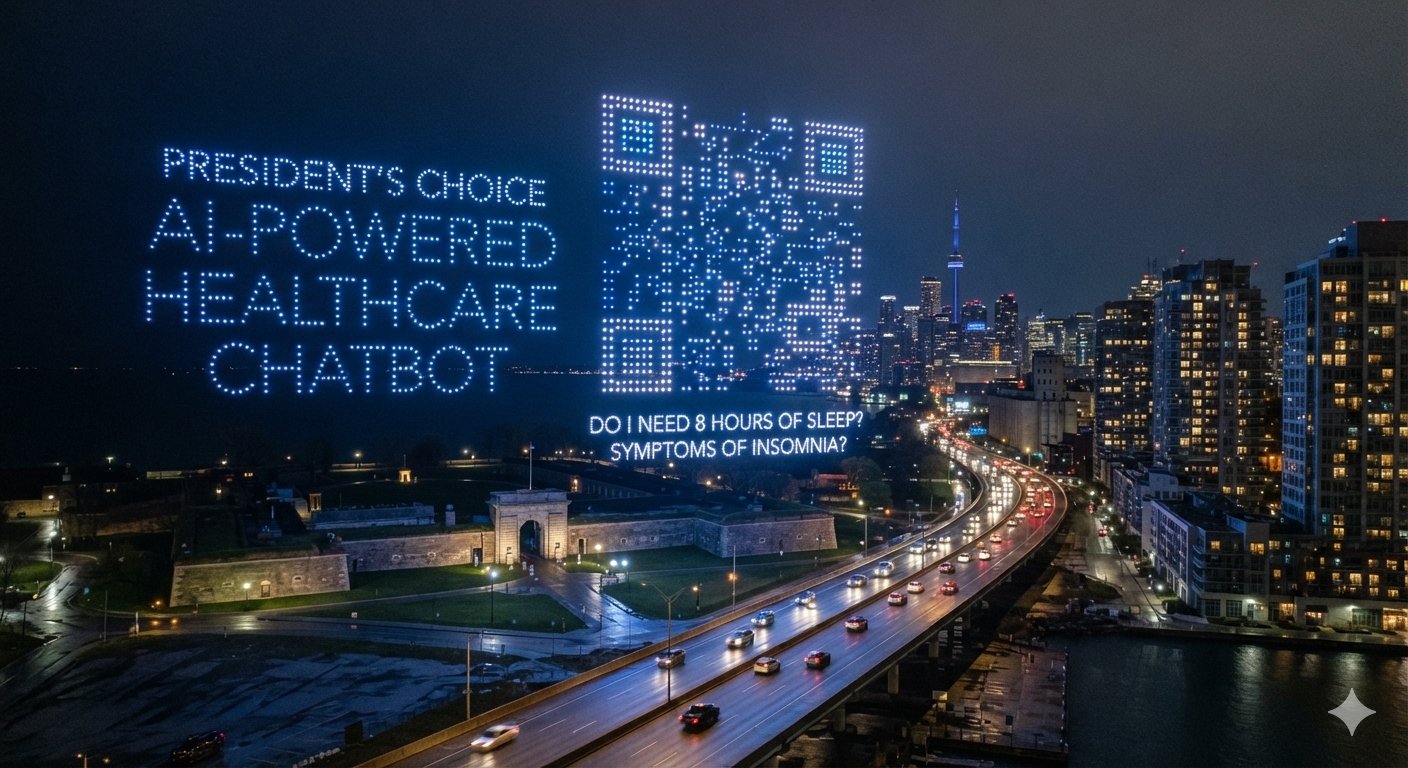

For 15 minutes on a clear Toronto night, the skyline over the city's inner harbour became a digital billboard. A synchronized fleet of more than 1,000 glowing drones pulsed against the dark, hovering directly over the Fort York Historic Site. The aircraft twisted into formation, projecting massive, illuminated health questions across the urban canopy: "Can Melatonin lose its effect?", "Do I really need 8 hours of sleep?", and "What are the symptoms of insomnia?" The display concluded by locking into a colossal, glowing QR code hovering near the Gardiner Expressway.
The late-night marketing campaign on Thursday, September 10, 2026, was designed by Loblaw Companies Limited to launch its new President’s Choice AI-powered healthcare chatbot. While the technical execution of the flight was precise, the reaction on the ground was immediate and highly critical. To thousands of residents living in Toronto’s high-density waterfront neighborhoods, the visual intrusion felt less like a modern convenience and more like an unwelcome corporate disruption.
The incident has triggered an intense local debate regarding community standards, corporate ethics, and the regulatory vacuum surrounding public airspace.
"What Dystopian Hell Is This?"
The irony of the campaign's theme was quickly pointed out by a weary downtown population. At roughly 11:00 p.m.—a time when city noise and light guidelines typically encourage quiet hours so residents can sleep—Loblaws chose to flash insomnia symptoms directly into high-rise bedroom windows.
"What dystopian hell is this?" wrote one resident on Reddit, sparking a thread that rapidly accumulated hundreds of complaints from nearby condo owners. For people living in the high-rises bordering Fort York, the drones were an inescapable flash of light illuminating their living spaces. Drivers navigating the Gardiner Expressway also reported being caught off guard by the sudden appearance of a massive, shifting light array, which created a hazardous visual distraction on a busy stretch of highway.
Marketing strategies frequently push conventional boundaries, but aerial drone advertising represents a major shift in how corporations interact with urban environments. Unlike a traditional billboard, which occupies a fixed piece of legally zoned private property, a drone swarm operates in the public commons. Neighbors noted that while you can look away from a standard roadside advertisement or turn off a digital device, an unauthorized aerial display leaves citizens with no option to opt out.
A Regulatory Gap for Cities
The Toronto drone campaign has exposed a significant gap between rapid technological capabilities and existing municipal policy. Local urban planner and licensed drone operator Sean Galbraith, speaking on CBC Radio’s As It Happens, pointed out the complications of allowing commercial interests to self-regulate the sky. Galbraith noted that while traditional static advertisements are heavily regulated for size, brightness, and residential placement, dynamic drone swarms currently operate in a regulatory gray area.
In Canada, airspace falls under the federal jurisdiction of Transport Canada. However, their mandate focuses strictly on aviation safety, vehicle weight classes, and flight paths—not the aesthetic, psychological, or commercial impact of what those flights project onto neighborhoods. This leaves municipalities flat-footed when displays cause local disruption.
To make matters worse for frustrated residents, the City of Toronto confirmed that local officials were not made fully aware of the sheer scale or the promotional nature of the late-night deployment. Ward 10 City Councillor Ausma Malik is now facing mounting pressure from constituents to close the loopholes in commercial flight and noise bylaws. Existing city ordinances are designed to penalize stationary noise and ground-based light pollution; they are simply not built to handle an agile, temporary army of a thousand flying computers.
Heightened Public Sensitivity
The public's sharp reaction is also tied to ongoing consumer frustration with Canada's major grocery chains. Loblaws is already operating under intense public scrutiny due to years of high grocery prices, record corporate profits, and a recent national consumer boycott.
Against this economic backdrop, spending heavily to illuminate the night sky for an AI tool felt remarkably tone-deaf to many critics. Community members pointed out the hypocrisy of a company disrupting the sleep of working-class urban residents to market a chatbot meant to treat sleep deprivation.
Additionally, using an aggressive advertising stunt to pitch an AI healthcare chatbot touches on a broader societal frustration. As Canadians navigate a strained public healthcare system, a corporate tech alternative—a scannable sky code leading to an algorithmic diagnosis—strikes many as an inadequate substitute for tangible medical infrastructure.
Setting a Precedent for the Future
The fallout from Toronto’s night under the drones serves as a warning for city planners. As autonomous drone technology becomes cheaper and easier to scale, the temptation to transform the night sky into a rotating scroll of digital advertisements will only grow. If a grocery chain can claim the skyline over a historic site on a Thursday night without municipal interference, there is little to stop other major corporations from blocking out sunsets across the country.
The widespread anger in Toronto proves that citizens still view the skyline as a shared public sanctuary rather than an unregulated canvas for commercial monetization. If municipal governments do not act quickly to establish strict zoning laws for commercial sky advertising, the natural night sky risks being permanently commercialized.

Comments
There are 0 comments on this post