
Flip the Script: Why Maine should just join Canada already

If the latest round of late-night, caps-lock social media posts from the White House is any indication, American political strategy has officially uncoupled from reality. Between escalating tariff battles, a grinding consumer travel boycott, and Washington’s bizarre attempts to interfere in the domestic politics of Alberta, the cross-border relationship has reached a point of unprecedented friction.
But nothing captures the sheer, unadulterated absurdity of the current moment quite like the administration's recent executive order directed at the smallest of the Great Lakes. In an act of pure geopolitical vanity, the U.S. President formally directed federal databases and mapmakers to rename Lake Ontario to "Lake America", leaving tech giants like Apple Maps scrambling to update their software for U.S. users while the rest of the world looks on in disbelief.
For years, the conventional wisdom was that the United States held all the cards in North American geopolitics. But as Washington continues to treat its closest trading partner as an economic punching bag, the time has come to challenge that assumption. Instead of watching a volatile U.S. administration try to micro-manage Canadian provinces, it is time to flip the script. Rather than enduring endless trade wars, Canada should extend a historic, bold counter-offer to the most logical, culturally synchronized state in the Union. It is time for Maine to cross the threshold, pack its bags, and officially apply to become Canada’s 11th province.
This is no longer just the stuff of satirical social media campaigns or border-town daydreaming. Deep within the borders of the Pine Tree State, the idea has begun moving from a punchline to a serious point of reflection among citizens exhausted by federal instability. As economic pain from the trade war deepens, regular citizens are openly venting in local forums. In a widely circulated letter published by the Portland Press Herald, one local reader explicitly argued that given the persistent chaos south of the border, the region would find far better stability under a different flag. The sentiment has echoed across the state, with contributors to outlets like Central Maine writing columns that plead, quite literally: "Please, Canada, take Maine in."
The core driver of this push is a massive economic win-win that Washington simply cannot replicate. Maine’s economy is fundamentally built on its relationship with Canada, sending over 41% of its international exports straight north. When Washington picks a fight with Ottawa, Maine is the one that gets the economic equivalent of a black eye. By officially integrating into the Great White North, Maine would secure instant, permanent relief from the Canadian consumer boycott on American products, travel, and hospitality.
Consider the immediate relief for the state's tourism and hospitality sectors. For the past two years, local border businesses, coastal bed-and-breakfasts, and historic main streets have languished under cross-border restrictions and retaliatory measures. Governor Janet Mills recently reminded the public that the border truly belongs to the "everyday Mainers and Maritimers" who trade, vacation, and build lives together, lamenting that federal trade wars put local communities in the crosshairs of a fight they didn't start.
By removing the border entirely, the summer traffic would return seamlessly. Instead of spending millions on marketing campaigns desperately trying to lure Quebecers and Maritimers back to the coast, Maine could just take down the toll booths. The border friction would vanish, the export lines for lumber and blueberries would clear overnight, and local businesses could finally breathe a sigh of relief. Maine would instantly transform from a geographically isolated "end-of-the-road" U.S. state into a vital, central hub of Canada's eastern maritime economy.
But the advantages stretch far beyond rescuing supply chains and stabilizing the price of lobster. Joining Canada would provide an immediate, compassionate sanctuary for the state's residents. While the current U.S. administration coordinates political rollbacks targeting vulnerable populations and seeking to strip away protections for transgender individuals, Canada offers robust, constitutionally enshrined human rights protections. For everyday citizens, the choice would come down to a foundational philosophical shift: trading the volatile, increasingly lawless environment of a declining empire for the foundational promise of the Canadian constitution—Peace, Order, and Good Government.
Furthermore, making the jump would ironically grant Mainers more local control over their own lives, not less. In the American federal model, states are increasingly subject to aggressive federal mandates, judicial overreach, and wild political swings in Washington. In Canada, however, the division of powers heavily favors the regions. As the province of Alberta has aggressively demonstrated through its pursuit of sovereignty acts and institutional autonomy, a Canadian province wields immense constitutional power. Provinces maintain strict authority over their own natural resources, healthcare networks, labor laws, and local social systems.
This provincial firewall creates a unique geopolitical safety valve for Maine. If the state were to join Canada, it would do so knowing that it possesses the constitutional muscle to run its own affairs without a federal government constantly breathing down its neck. More importantly, because of this highly decentralized system, Maine would retain the ultimate flexibility. If the political climate in Washington ever truly stabilized, and if the United States once again became a safe, predictable neighbor, Maine’s provincial framework would allow it the political leverage to re-negotiate its position or even seek to switch back to the United States from a position of strength. It is a level of regional sovereignty an American state can only dream of.
Then there is the structural crown jewel: universal public healthcare. Maine has spent over a decade fighting a severe, underfunded substance abuse crisis on a localized level, all while regular families collapse under the weight of skyrocketing private healthcare costs and corporate insurance premiums. Trading confusing deductibles, out-of-pocket gaps, and predatory corporate networks for a provincial health card would provide immediate, sweeping relief to the state's aging demographic. It would allow the region to finally treat healthcare and addiction support as a stable public utility rather than a corporate profit center.
The geopolitical crown jewel of this integration, however, would sit right on Seavey's Island: the transformation of the Portsmouth Naval Shipyard into CFB Kittery (Canadian Forces Base Kittery). As a premier base for the Royal Canadian Navy, this multi-billion dollar dry-dock facility would become Canada's most advanced naval asset, anchoring its next-generation Atlantic submarine command and guarding the vital shipping lanes of the eastern seaboard. Rather than abandoning its massive workforce, a historic cross-border treaty would fast-track special Canadian security waivers for the thousands of skilled New Hampshire commuters who already power the yard. They would keep their jobs, punch their clocks, and get paid in a stable economy, while Canada inherits a world-class strategic stronghold.
Crucially, the region’s indigenous nations—the Maliseet, Micmac, Passamaquoddy, and Penobscot (collectively the Wabanaki Confederacy)—would experience a profound and long-overdue legal upgrade. For decades, Maine's tribes have been uniquely oppressed by the rigid constraints of the Maine Indian Claims Settlement Act of 1980, which strips them of the inherent sovereign rights enjoyed by other federally recognized U.S. tribes. Shifting to Canada would instantly grant them protection under Section 35 of the Canadian Constitution Act, 1982, which recognizes and affirms inherent Aboriginal and treaty rights.
Erasing the colonial border would seamlessly reunite these fractured nations with their sister tribes in New Brunswick and Nova Scotia. This would allow for unified tribal governance, unfettered cultural migration, and shared natural resource management without international interference. Inside Canada, the Wabanaki would gain immense leverage through modern land claims and powerful Supreme Court precedents, giving them unprecedented veto power over forestry and industrial development on their ancestral lands.
In terms of federal representation, Maine would instantly become a major player on the Canadian stage. With a population of roughly 1.4 million people, Maine would rank as Canada’s 5th largest province—just behind Alberta but ahead of Manitoba. Under Canada's electoral quota system, Maine would be allocated 13 seats in the House of Commons, turning cities like Augusta, Portland, Bangor, and Lewiston-Auburn into critical federal ridings. Furthermore, to ensure parity without diluting the existing Atlantic provinces, a constitutional amendment would grant Maine its own regional allocation of 6 to 10 Senate seats, giving Mainers a powerful, permanent voice in shaping national policy.
The 15-Year Road to Confederation
Executing this geopolitical shift would be a massive legal, structural, and bureaucratic undertaking. Policy experts outline a realistic 15-year, four-phase transition plan required to peacefully untangle Maine from the United States and integrate it into Canada.
Phase 1: The Domestic Push & Legal Groundwork (Years 1–3)
Before international talks can begin, Maine would have to clear its own domestic hurdles, navigating both local political desire and rigid federal blockades.
- Year 1 (The Non-Binding Referendum): A massive public campaign leads to a statewide advisory referendum. Mainers vote overwhelmingly "Yes" to exploring Canadian integration. While legally non-binding, it gives the Maine legislature a popular mandate to act.
- Year 2 (The U.S. Constitutional Crisis): Maine files a formal petition for secession to the U.S. Congress. Because the Supreme Court ruled in Texas v. White that the Union is indissoluble, Congress initially rejects it. Maine launches a multi-state lobbying effort, arguing that an amicable divorce is better than forced economic ruin.
- Year 3 (The Congressional Exit Act): Facing intense economic paralysis from the ongoing trade war, Congress passes a specific federal statute allowing Maine to secede, conditioned on Maine assuming its proportional share of the U.S. national debt.
Phase 2: International Treaty & The Canadian Accord (Years 4–6)
With permission to leave the U.S., Maine must negotiate its entry into Confederation, requiring approval from Ottawa and the existing provinces.
- Year 4 (The Ottawa-Augusta Summit): Formal diplomatic talks begin between the Canadian federal government, the Maine State Legislature, and representatives from the Atlantic Provinces. They draft the Maine Accession Accord.
- Year 5 (The Canadian Constitutional Amendment): Under Canada’s 7/50 constitutional amendment rule, admitting Maine as a brand-new province requires the approval of the federal Parliament plus at least seven provincial legislatures representing 50% of Canada's population. Intense negotiations occur regarding Maine's seat allocation in the House of Commons and Senate.
- Year 6 (The Dual Ratification): The U.S. Senate ratifies a treaty recognizing Maine's independence, while the Canadian Parliament officially passes the Maine Act, welcoming the territory into Confederation.
Phase 3: Structural Harmonization & The Transition Period (Years 7–10)
This is the most disruptive phase, where everyday systems, laws, and infrastructure are completely rewired. To navigate this phase, a Joint Transition Taskforce organizes community town halls to map out immediate updates for residents:
| Date & Time | Location | Primary Focus Sector | Key Discussion Points |
|---|---|---|---|
| October 14, Year 7 7:00 PM – 9:00 PM | Bangor Arts Center Bangor, ME | The USD-to-CAD Switchover | • Timeline for bank account conversions. • Swapping out physical cash at local banks. • Adjusting retail POS systems and price tags to CAD. |
| March 11, Year 8 7:00 PM – 9:30 PM | Merrill Auditorium Portland, ME | The Maine Health Insurance Plan | • Dissolving private employer deductibles. • Issuing the new Provincial Health Card. • Continuity of care for patients with existing treatments. |
| June 22, Year 10 6:30 PM – 9:00 PM | Kittery Community Center Kittery, ME | The New Interstate Frontier | • Working conditions for New Hampshire commuters on Seavey's Island. • Border checkpoint logistics on Interstate 95. • Customs limits on cross-border shopping. |
- Year 7 (Currency & Financial Day One): The U.S. Dollar is phased out over a 12-month period, replaced by the Canadian Dollar (CAD). The Canada Revenue Agency (CRA) establishes operations in Augusta to transition businesses from U.S. federal taxes to the GST and provincial tax brackets.
- Year 8 (The Health Care Rollout): Private insurance networks are dissolved or relegated to supplemental care. The Maine Health Insurance Plan is launched, funded by provincial taxes and federal Canada Health Transfers, granting all residents universal access.
- Year 9 (Regulatory Realignment): Maine businesses switch to Canadian labor standards, environmental codes, and agricultural quotas. The lobster industry harmonizes with the Department of Fisheries and Oceans (DFO), establishing joint management zones with New Brunswick and Nova Scotia.
- Year 10 (Border Dissolution): The 611-mile international border between Maine, Quebec, and New Brunswick is completely dismantled. Border checkpoints are moved south to the new international boundary along the New Hampshire and Massachusetts borders, completely upending interstate commuting and tax-free shopping corridors across the Piscataqua River.
Phase 4: Full Integration & Local Sovereignty (Years 11–15)
Maine takes its place as a fully functioning sovereign entity within the Canadian federal system, utilizing its new provincial autonomy.
- Year 11 (The First Provincial Election & Language Accord): The Maine State Legislature officially dissolves and is replaced by the Legislative Assembly of Maine. Voters elect their first Premier. To maximize trade, tourism, and diplomatic goodwill along the 311-mile border with Quebec, the new Assembly passes the Maine-Quebec Cross-Border Language Accord. Rather than imposing bureaucratic language hurdles on its own citizens, Maine adopts a pragmatically focused, voluntary bilingualism policy:
- Government Gateways: All major provincial web portals, tourism applications, and business registration tools are required to have mirror interfaces in French.
- Border Corridors: Transport Maine ensures all highway signage within 50 miles of the Quebec border uses standard international pictograms and bilingual text (English and French).
- Education Immersion: Public school districts that introduce voluntary French Immersion tracks starting in kindergarten receive an additional 15% in provincial funding per student.
- Private Sector Freedom: Local storefronts, restaurants, and labels inside Maine are completely exempt from language quotas. Small businesses in northern border towns like Madawaska receive a local tax credit if they voluntarily choose to provide bilingual menus or customer service staff.
- Year 12 (Infrastructure & Crown Corporations): Pine Tree Power is fully established as a provincial Crown Corporation, directly interconnecting Maine's grid with Hydro-Québec to secure cheap, tariff-free renewable energy.
- Year 15 (The Sovereignty Valve Activation): Having stabilized its economy, secured universal healthcare, and insulated its minority populations, Maine exercises the robust provincial rights modeled by Alberta. It establishes its own provincial police force and formalizes a legal framework allowing it to review its status if geopolitical conditions in the United States ever safely stabilize.
Counter-Absurdity: Channeling the Spirit of New Ireland
While a 15-year constitutional separation requires immense patience, the people of Maine do not have to wait a decade to push back against Washington's economic hostility. The history books offer a blueprint.
During the War of 1812, British forces successfully occupied eastern Maine and established the Colony of New Ireland. For eight months, the region was governed under British-Canadian jurisdiction, building deep maritime bonds before the Treaty of Ghent forced a return to the American fold. If the region had stayed under that northern administration, it would be a totally different place today—prosperous, historically integrated with the Maritimes, and entirely unbothered by U.S. domestic policy swings.
The absolute strongest way for the people of Maine to respond to the White House's erratic trade bullying is to invoke the ghost of this lost history. When U.S. President Donald Trump arbitrarily signs orders trying to redraw maps and annex geographic names, the response shouldn't be hand-wringing. The best way to answer structural absurdity is to follow the lead of Canadian Prime Minister Mark Carney. When Trump targeted Canadian industries, Carney responded immediately with firm, dollar-for-dollar counter-tariffs.
Maine should match that energy by launching a campaign of counter-absurdity.
If the White House can call Lake Ontario "Lake America," the Maine State Legislature should formally pass a symbolic resolution renaming the state "The Autonomous Province of New Ireland" as a direct protest against the federal policies choking its economy.
Until a formal treaty can be signed, town councils across Maine—especially those along the border and coast most deeply harmed by U.S. isolationism—can take matters into their own hands completely legally. Municipalities have the corporate authority to rename their local jurisdictions; selectboards could vote to rename their towns after Canadian locations, transforming local municipal maps into a tapestry of solidarity with New Brunswick and Quebec.
Even more powerfully, these town councils could issue a stark ultimatum to the White House: end the economic nonsense, or local municipal buildings will simply begin flying the Canadian Maple Leaf flag in place of the Stars and Stripes. Counter-outrageousness offers a brilliant short-term pressure valve, using perfectly legal methods to emulate federal theatrics and demonstrate that if Washington wants to treat its closest allies like foreigners, its most dependent border state will gladly act the part.
Mainers and Atlantic Canadians already share the same DNA. They share the same brutal winters, a mutual dependence on the sea, a cultural love of flannel, and a deep exhaustion with the continuous political reality-television show broadcasting out of Washington. If the U.S. federal government is going to continue treating its closest ally as an adversary, Maine should choose the ultimate exit option. They have the geography, they have the values, and they have the economic incentive. It’s time to bring Maine home to the Great White North.
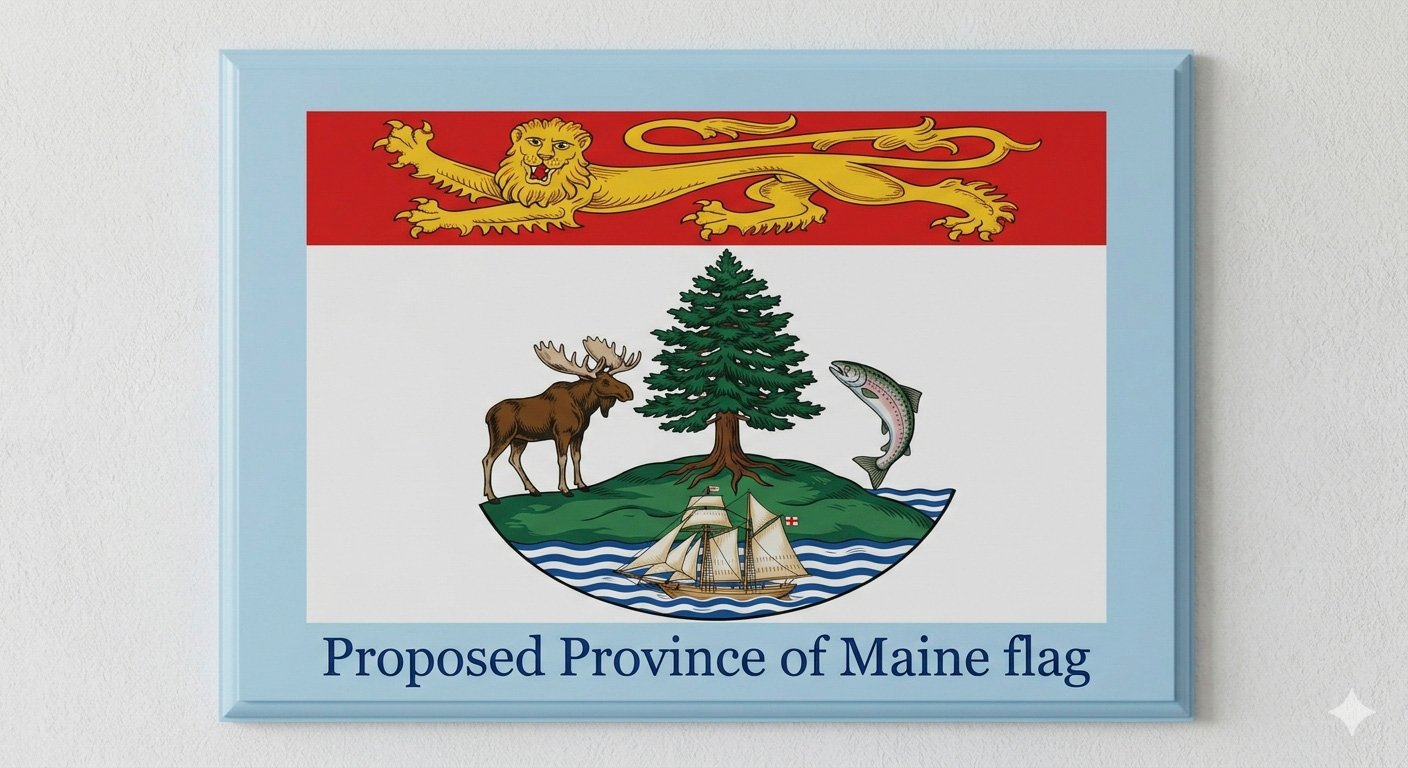
Proposed Visual Identity for the Province
To cement this visual pivot toward the Atlantic tradition, vexillologists have proposed a new provincial banner that completely ditches the generic American layout in favor of a classic Canadian landscape story.
This design pays direct homage to the region's shared history, featuring the traditional gold lion of the Atlantic provinces across the top third, with the central pine tree flanked by the native moose and Atlantic salmon, all resting above a traditional lumber schooner navigating the waves of the eastern seaboard. It is a flag designed not just to represent a territory, but to kickstart a conversation.

Comments
There are 0 comments on this post