
Carney pursues dismantling Indian Act alongside claims of harassment against Indigenous woman

On August 4, 2023, Josie did what any person should have the fundamental right to do: she asserted her inherent right to be treated with dignity and respect under natural law. As a Mohawk First Nations woman, she spoke up about her rights, attempting to understand why she was being targeted, cornered, and treated with immediate, unprovoked hostility. Instead of receiving a measured, professional response from an officer sworn to uphold peace and justice, Josie’s assertion of her basic humanity was treated as a direct challenge to state authority. The officer escalated the interaction almost instantaneously, weaponizing institutional rhetoric by labelling her a "freeman"—a derogatory characterization intended to dismiss her identity, misclassify her standing, and strip away the legitimacy of her sovereign status as an Indigenous person.
When Josie attempted to document the encounter with her cellphone, the officer crossed an unacceptable boundary. He seized her device, eliminating any objective record of his conduct, and violently pulled her from her vehicle under the pretext of searching for her identification. Josie was subsequently handcuffed and placed in the back of a police cruiser. During this terrifying escalation, the officer made a statement that has haunted Josie ever since: “This is Canada, I don’t need a reason.”
For an Indigenous woman, those eight words are terrifyingly familiar. They articulate the unspoken ethos of a colonial policing structure that has operated on Canadian soil for more than a century: the belief that the state possesses unlimited discretion, unchecked force, and an absolute exemption from accountability when dealing with Indigenous bodies. It declared, in no uncertain terms, that Josie had no right to dignity, no right to ask questions, and no right to expect constitutional protections. Today, this roadside encounter forms a central part of Josie's active human rights complaint against the RCMP under the Canadian Human Rights Act, alleging discrimination based on her national or ethnic origin, sex, and disability.
The Federal Rhetoric: Dismantling the Indian Act
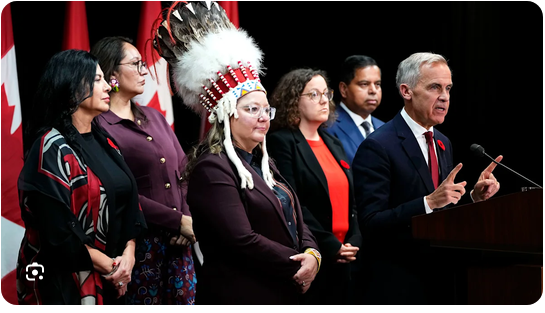
While Josie’s ongoing struggle underscores the immediate, dangerous failures of state protection on the ground, the federal government under Prime Minister Mark Carney has engaged in high-level debates regarding the overarching framework of Crown-Indigenous relations. In late October 2026, during a landmark First Nations–First Ministers meeting in Ottawa, Manitoba Premier Wab Kinew made a surprise call to abolish the 1876 Indian Act, labelling it an archaic, race-based mechanism of control. Prime Minister Carney stated he was "very open to" moving Canada past the Indian Act, describing the law as racist and anachronistic, though he later noted that discussions could lead to reform rather than complete abolition.
However, the political push by Carney and Kinew to dismantle or reform the Indian Act highlights a profound disconnect between federal rhetoric and the daily lived realities of Indigenous women. Assembly of First Nations National Chief Cindy Woodhouse Nepinak pushed back against the narrative that there was a consensus in the room, pointing out that First Nations chiefs were focused on immediate legislative threats to their rights rather than broad-stroke promises of abolition.
For women like Josie, macro-level debates about dissolving historical statutes ring hollow when the state's enforcement arms continue to treat Indigenous women with hostility. The Indian Act historically institutionalized state control over Indigenous identity and governance, but the culture of colonial policing remains actively enforced on Canadian roadsides. Meaningful change must extend far beyond high-level legislation and political statements; it must be reflected in the everyday treatment, dignity, safety, and protection of Indigenous women.
The Anatomy of Institutional Neglect
Josie’s violent encounter on August 4, 2023, cannot be understood in isolation. It was not a localized misunderstanding or an isolated breach of protocol by a single "bad apple." For Josie, this roadside assault was the catastrophic culmination of years of systemic police indifference and bureaucratic abandonment.
Since 2020, Josie had meticulously documented persistent, terrifying incidents of stalking, criminal harassment, and threatening communications directed at her personal safety, including concerning activity around her residences. She did not act outside the system; she followed every procedure established by Canadian law. She compiled an extensive, chronological evidentiary report and formally submitted it to the RCMP in Prince Edward Island in late 2023, pleading for a competent criminal investigation and meaningful protection. She continued trying to obtain assistance from police services across different jurisdictions.
Rather than receiving protection, Josie was met with an impenetrable wall of apathy and inaction. Her documented pleas were minimized, delayed, and effectively dismissed. This prolonged pattern of police neglect left her in a state of ongoing vulnerability, compounding her distress and leading to a terrifying reality: police inaction was providing de facto impunity to the perpetrators, allowing their harassing behaviour to escalate unchecked. This history is vital to understanding why she was seeking protection and why the August 2023 encounter further shattered her confidence in law enforcement. The institution tasked with providing a shield had become the sword.
A Long History of Institutional Violence and Oversight Failure
The trauma experienced by Josie connects directly to the founding purpose of Canadian colonial policing, which has historically worked hand-in-hand with federal legislation to enforce compliance. The issues raised by Josie are supported by formal rulings and reports from human rights bodies across the country:
A notable precedent is the decision by the Canadian Human Rights Tribunal in Woodgate et al. v. RCMP (2026 CHRT 15). In that case, the Tribunal substantiated a complaint from Lake Babine First Nation survivors, finding that the RCMP discriminated against Indigenous complainants through reckless conduct and a failure to provide culturally competent services. Significantly, the federal Department of Justice intervened to challenge the ruling, arguing that criminal investigations do not qualify as a public "service" covered by the Canadian Human Rights Act. This legal strategy illustrates the lengths to which state institutions will go to shield themselves from human rights oversight. When Josie was told "I don't need a reason," she was encountering that very same institutional argument: that the police operate beyond the reach of standard human rights accountability.
This systemic dynamic extends across the country. In August 2014, 15-year-old Tina Fontaine, a member of the Sagkeeng First Nation, crossed paths with the Winnipeg Police Service while in a vulnerable state. The officers failed to take protective custody of her, and nine days later, her body was recovered from the Red River. Tina’s case became a catalyst for the National Inquiry into Missing and Murdered Indigenous Women and Girls, which issued 231 Calls for Justice explicitly declaring that the historic and ongoing treatment of Indigenous women by Canadian institutions constitutes a form of genocide.
Similarly, along British Columbia’s Highway 16, known as the Highway of Tears, dozens of Indigenous women and girls have disappeared or been murdered over decades, with families noting that their reports were met with police dismissiveness and stereotyping. In the landmark report Those Who Take Us Away, Human Rights Watch compiled firsthand accounts detailing how RCMP officers engaged in abusive conduct, finding that Indigenous women were trapped in a double bind: they could not rely on the RCMP for protection, yet they faced disproportionate police aggression.
Identity, Disability, and the Reality of Discrimination
Josie’s active human rights case directly confronts how these broader systemic failures intersected with her own identity on that August roadside. Her complaint specifically addresses discrimination based on her national or ethnic origin, sex, and disability. During the high-stress interaction, Josie was experiencing visible distress. Despite this, the attending officer failed to recognize, respect, or accommodate her physical disabilities, choosing physical escalation over basic safety and care.
By weaponizing the "freeman" label, the officer attempted to completely delegitimize a Mohawk woman's appeal to natural law and inherent sovereignty—legal and philosophical frameworks recognized across First Nations, affirmed by international conventions such as the UN Declaration on the Rights of Indigenous Peoples (UNDRIP), and protected under Section 35 of the Constitution Act, 1982. Conflating an Indigenous woman's demand for basic respect with an anti-government extremist movement allows law enforcement to reframe a human rights appeal as a physical threat, establishing a dangerous administrative pretext to disregard a citizen's physical vulnerabilities and strip away their dignity.
The Core Question: Where Are Indigenous Women Supposed to Turn?
Josie’s case places her personal experience and her ongoing human rights tribunal case directly within the larger, national discussion about Indigenous sovereignty, equality, reconciliation, and the responsibility of federal institutions. For Indigenous peoples, sovereignty and reconciliation cannot be limited to theoretical political discussions or government policy adjustments. They must be measured by how Indigenous women are treated when they approach federal institutions for assistance and protection.
The federal government's commitments to Indigenous rights must be evaluated not by the elegance of their proposed legislative amendments, but by whether a First Nations woman can access police services without experiencing discrimination, intimidation, or physical harm.
Josie’s experience poses a question that Canadian society, its courts, and its political leaders must answer: When federal leaders debate the future of the Indian Act on the national stage, but local police treat an Indigenous woman’s demand for basic respect and disability accommodation as an offence, where is she supposed to turn for protection?

Comments
There are 0 comments on this post