
How foreign speculators undermine community across Canada

For generations, the unwritten bargain of Canadian citizenship was defined by a shared expectation of community stability. If you contributed diligently to the economy, you could eventually anchor your life in a home of your own, within a neighborhood where children played, local schools thrived, and civic roots deepened over decades. It was a foundational piece of social architecture that transformed a vast, disparate geography into a stable, middle-class democracy.
Today, that bargain is being systemically dismantled by structural economic forces that go unaddressed by our national leadership. If you step into the residential real estate market in any major Canadian urban or suburban hub, you are no longer engaged in a fair competition against your peers. You are standing in the path of a silent, institutional bulldozer.
Across our provinces, a staggering portion of entry-level housing stock is no longer held by human beings. Property registries are increasingly populated by faceless corporate entities—names like 10002345 Ontario Inc. or 994821 BC Ltd. These numbered shell companies act as legal cloaks, allowing speculative funds, private equity syndicates, and ultra-wealthy domestic and international buyers to vacuum up local real estate entirely anonymously.
International transparency advocates have long warned that Canada suffers from a chronic vulnerability to "snow washing"—the practice of cleaning or parking capital within our highly stable, lightly regulated residential housing market [Global News]. Because our beneficial ownership disclosure laws have historically lagged behind global standards, an investor can route money through layered legal trusts and shell companies without ever revealing their true identity to the community they are altering [Transparency International Canada].
When an institutional fund or a numbered corporation looks at a modest suburban townhome or a starter condo, they do not see a piece of civic infrastructure where a family can plant roots. They see a financialized asset class with a captive customer base. Backed by algorithmically driven data and endless cash reserves, these entities can close deals within hours, routinely shutting out young families who require traditional mortgage approvals.
The Influx of Foreign Speculative Aggression
This financialization is compounded by foreign speculative investment that operates in direct opposition to Canada's national interest. For over a decade, international capital pools have viewed Canadian residential real estate not as a social foundation, but as a sovereign-backed insurance policy—a liquid asset class in which to hedge against instability elsewhere.
When foreign capital flows unrestricted into low-density housing markets, it exerts a predatory pressure on domestic buyers. Global hedge funds and offshore syndicates utilize complex corporate layers to bypass existing foreign-buyer restrictions, distorting localized supply-demand metrics. This influx alters domestic monetary transmission; local interest rate adjustments by the Bank of Canada cannot cool demand when offshore buyers execute multi-million dollar acquisitions entirely in un-leveraged cash.
By allowing foreign entities to utilize Canadian neighborhoods as abstract capital storage facilities, public policy actively prioritizes global portfolio diversification over domestic security. Treating domestic shelter as a commodities market strips away economic self-determination from citizens. It represents a transfers of generational wealth out of local communities and into the balances of non-resident stakeholders who bear no civic responsibility toward the municipalities funding the local infrastructure.
The Erosion of Affordability and Community Fabric
The adverse effects of corporate real estate concentration extend far beyond transaction pricing; they profoundly erode the quality of living and stability within Canadian communities. When neighborhoods transition from stakeholder communities to blocks of corporate-managed rentals, the social fabric devalues alongside local purchasing power. Rents are algorithmically optimized to the maximum legal limit each year, while maintenance costs are minimized to serve shareholder returns.
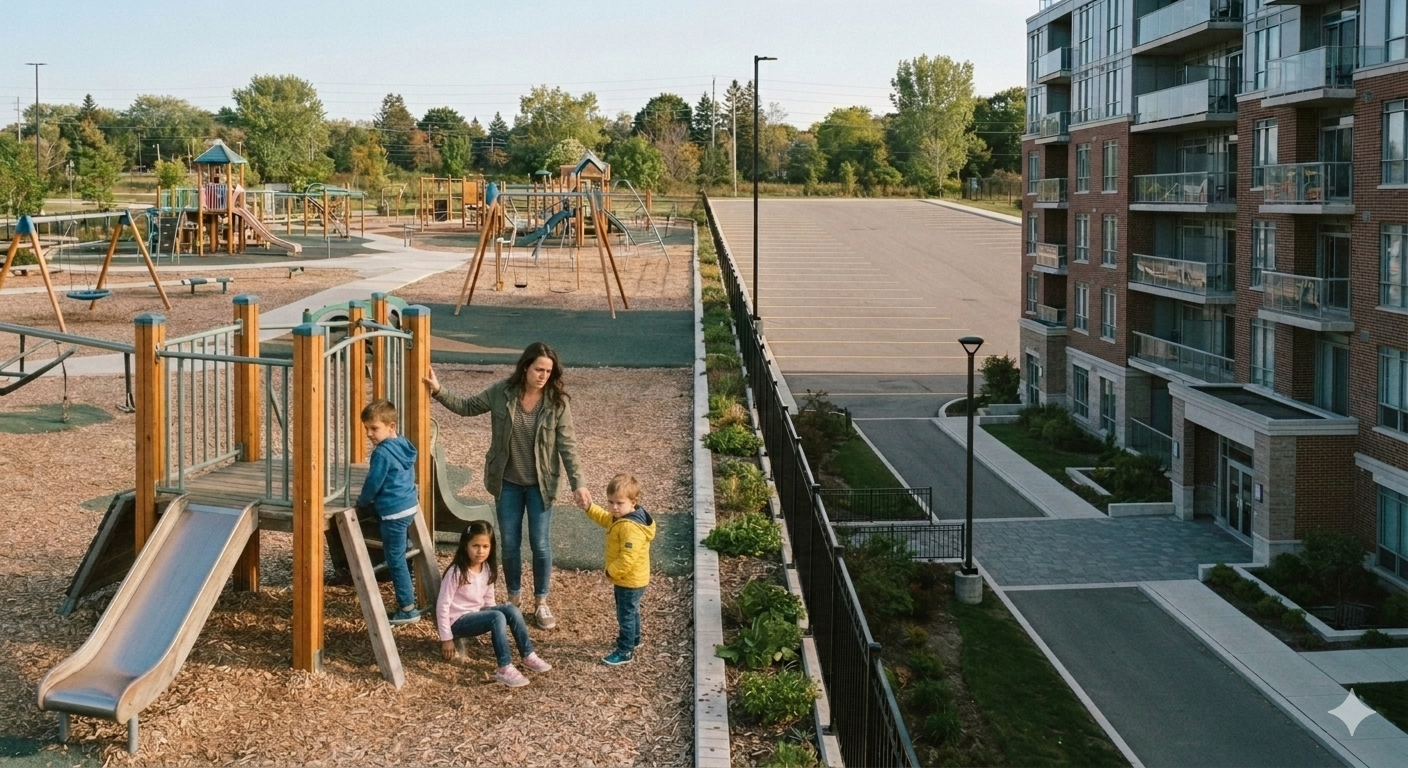
The human cost of this shift is visible in the sterile, eerie landscape of our newest developments. We are building massive housing complexes flanked by expansive, state-of-the-art playground facilities and sprawling concrete parking structures—yet they sit entirely empty. The children are missing. Young families, crushed by artificially inflated bidding wars and unviable rent-to-income ratios, are forced out of these urban cores entirely [Financial Post].
The result is a profound democratic paradox: master-planned concrete towers that serve as safe deposit boxes for corporate balance sheets, while the actual community space outside remains a ghost town. As streetscapes lose permanent residents, local school enrollments decline, neighborhood retail loses steady consumer bases, and local community associations struggle to maintain civic engagement. When neighborhoods are transformed into short-term corporate asset nodes, social cohesion disappears, replaced by high tenant turnover and institutional detachment.
The Federal Leadership Vacuum: The Carney Government’s Blind Spot
This structural erosion highlights the critical public policy blind spot of Prime Minister Mark Carney’s administration. The federal government’s housing strategy, anchored by the creation of the Build Canada Homes agency, seeks to ramp up prefabricated homebuilding, deploy public subsidies, and cut development charges. While these measures aim for necessary growth, they treat a deep financial and social crisis as an engineering and productivity problem. Building homes without curbing predatory corporate acquisition simply feeds new supply directly into corporate rental regimes, locking future stock away from affordable homeownership.
More critically, the Carney government has failed to exercise robust federal leadership in convening and sustaining vital federal-provincial discussions on corporate ownership limits, foreign capital tracking, and tenant protection standards. Instead of spearheading a coordinated national table to harmonize beneficial ownership enforcement, the federal government has insulated itself in centralized, supply-side rhetoric, leaving housing regulation fragmented across provincial and territorial jurisdictions. Championing nation-building mandates cannot be an excuse for avoiding the difficult, necessary intergovernmental discussions required to address the financialization of our communities.
The administrative reluctance to challenge institutional buyers stems from an outdated adherence to aggregate GDP growth targets. By focusing strictly on the economic output of real estate construction, the federal apparatus obscures the underlying decay in domestic standard of living. When corporate landlords squeeze local incomes to pay out-of-province or overseas shareholders, the domestic economy undergoes structural wealth extraction. Every dollar added to an artificial housing valuation represents capital diverted away from productive entrepreneurship, industrial innovation, and infrastructure enhancement.
Reclaiming the Canadian Commons
Reclaiming the Canadian dream requires shifting the environment from dark capital back to communities. This means enforcing absolute transparency via a pan-Canadian, fully searchable beneficial ownership registry where federal transfer funding is conditional on mandatory, open provincial land registry transparency. It requires provinces and municipalities to collaborate with Ottawa to establish strict acquisition limits or targeted surcharges on corporate entities buying up low-density housing stock.
Furthermore, federal tax codes must remove preferential tax treatments that reward excessive corporate leverage in residential real estate, while tightening anti-money laundering reporting requirements for private lenders and legal proxies. Foreign ownership bans must be re-engineered to audit the ultimate beneficial owners of numbered corporations, closing the corporate loopholes that allow global capital to hide behind domestic legal shields.
True nation-building is not simply a matter of pouring concrete and deploying public subsidies to developers. It requires defending the foundational democratic bargain: that Canadian communities exist to house their citizens, not to serve as anonymous, yield-generating instruments for global financial ledgers. Until we force these owners into the open, our neighborhoods will continue to hollow out, leaving behind empty playgrounds and a broken social contract.

Comments
There are 0 comments on this post