
OPINION | Mega City Mess: Top 10 Reasons to Return Toronto to a Metropolitan Government
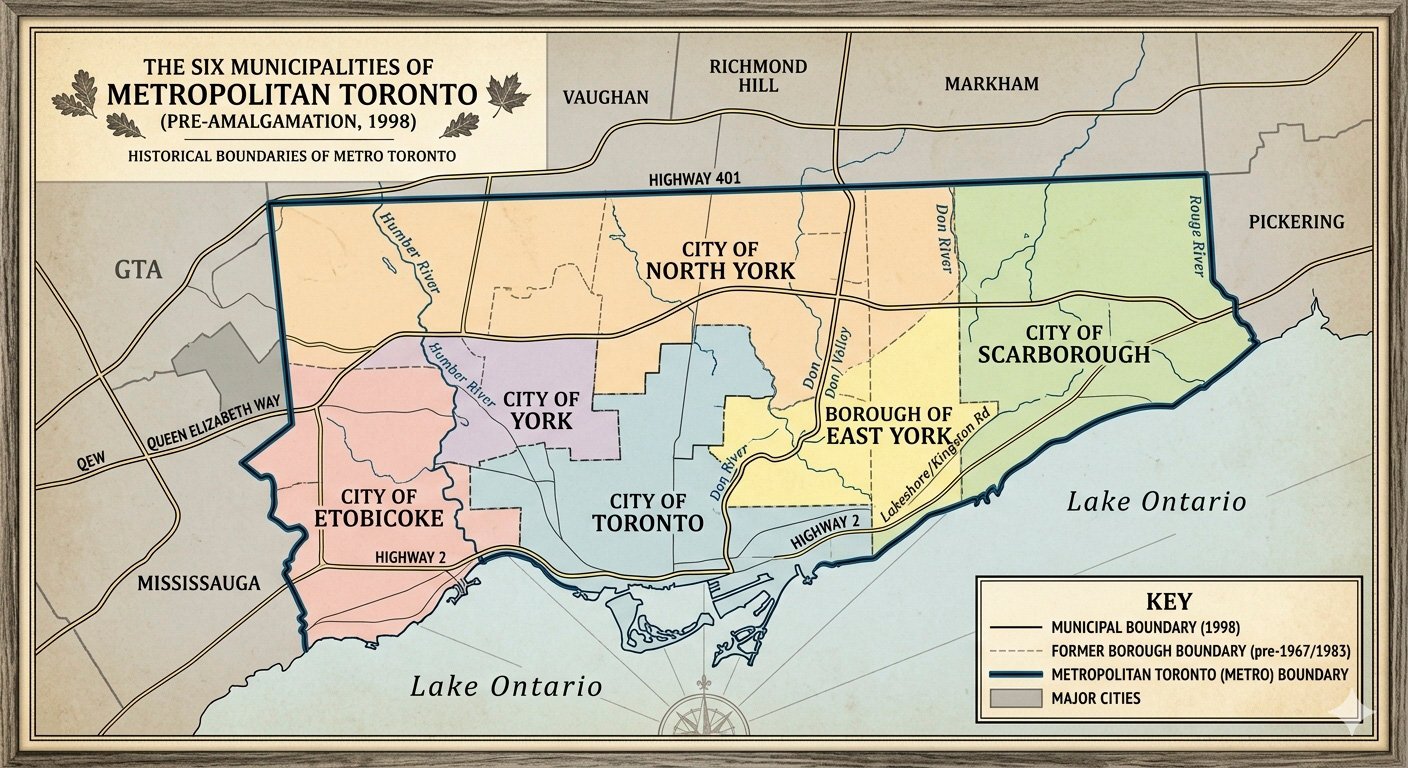

TORONTO — Nearly three decades after the provincial government forced the amalgamation of Toronto and its six surrounding boroughs into a single "Megacity," the civic experiment has largely broken down. What was promised as an exercise in fiscal efficiency has instead delivered a hyper-polarized, gridlocked, and bureaucratically bloated municipal government. The distinct geographic and economic needs of downtown urban centres cannot be effectively managed under the same monolithic blanket as low-density, car-centric suburbs.
To restore civic functionality, fiscal sanity, and democratic accountability, Toronto must dismantle its unmanageable single-tier structure. Returning to a two-tier Metropolitan Government framework—re-establishing local borough councils alongside a centralized regional authority—is the only way to rescue Canada's economic engine from its ongoing crisis.
Here are the top 10 reasons Toronto must return to a metropolitan government model:
1. Ending Bitter Suburban vs. Downtown Political Gridlock
Amalgamation forced vastly different political cultures into a zero-sum war at City Hall. Suburban councillors representing car-dependent wards routinely clash with downtown representatives advocating for walkable infrastructure and active transit. A two-tier metropolitan system allows local boroughs to set their own neighborhood priorities, ending the permanent ideological gridlock that paralyzes city-wide decision-making.
2. Restoring Local Democratic Accountability
In a city of three million residents, individual citizens have effectively lost access to their local government. A single city councillor in Toronto now represents well over 100,000 constituents—more than many provincial ridings. Re-establishing local borough councils shrinks the scale of governance, ensuring that community voices are actually heard on local zoning, parks, and neighborhood licensing.
3. Exposing the Myth of Amalgamation "Cost Savings"
The primary justification for the 1998 City of Toronto Act was that consolidating services would save hundreds of millions of dollars. Decades of data have proven this false. Instead of reducing costs, harmonization rules forced wages for municipal employees up to the highest existing suburban or urban benchmarks, creating a structurally bloated operating budget that strains taxpayers every year.
4. Rescuing the Fragmented Transit Network
The Megacity model has turned transit planning into an unstable political football, where multi-billion-dollar rapid transit lines are canceled or rewritten with every change in the Mayor's office. Under a metropolitan framework, a high-level regional authority like the former Municipality of Metropolitan Toronto would manage major transit corridors and expressway networks, while local boroughs handle neighborhood feeder routes, streetcars, and localized bike lanes.
5. Customizing Local Zoning and Planning Bylaws
A single, massive planning department has proven incapable of managing Toronto's diverse real estate landscape. Downtown high-density development requires entirely different planning mechanisms, heritage protections, and parkland dedication rules than the suburban subdivisions of Scarborough or Etobicoke. Returning planning powers to distinct boroughs allows for tailored, rapid growth strategies under the provincial Planning Act.
6. Optimizing Emergency and Civil Service Responsiveness
Consolidated emergency services have created massive, centralized bureaucracies that struggle with localized deployment. A metropolitan model allows a central agency to oversee macro-level infrastructure, specialized squads, and regional dispatch, while allowing local boroughs to manage their own fire stations, community police divisions, and neighborhood paramedics to ensure faster response times.
7. Rebalancing Infrastructure and Capital Spending
Under the current single-tier system, infrastructure budgets are constantly subject to geographic resentment, with outer boroughs claiming downtown gets preferential treatment and vice versa. A two-tier system separates local capital works from regional mega-projects, ensuring that neighborhood road repairs and community center upgrades are funded equitably without competing against major downtown infrastructure.
8. Protecting Distinct Civic Identities
Toronto's true strength lies in its diverse neighborhoods, yet amalgamation actively eroded the unique civic identities of historic municipalities like East York, York, and North York. Restoring distinct borough identities gives communities back their historical pride, local community boards, and the specialized cultural programming that was swallowed up by a generic corporate city brand.
9. Streamlining Bureaucracy and Reducing Administrative Bottlenecks
The sheer size of Toronto’s consolidated civil service has created an impenetrable wall of red tape. Small businesses, community groups, and local builders are routinely trapped in multi-year delays for basic permits. Splitting administration into a centralized regional tier and nimble local tiers cuts through the bureaucratic bloat, speeding up permit approvals and local licensing.
10. Creating a Predictable, Scalable Model for GTA Growth
The Greater Toronto Area is growing at an unprecedented rate, yet the Megacity framework remains rigid and structurally incapable of expanding past its 1998 borders. A metropolitan government model provides a flexible, modular template that can eventually be scaled up to integrate broader regional partners across the GTA, establishing a true, cohesive regional growth strategy under the Places to Grow Act.

Comments
There are 0 comments on this post